
Best ERP for Apparel Industry in 2026: Why CMT Factories Need Something Different
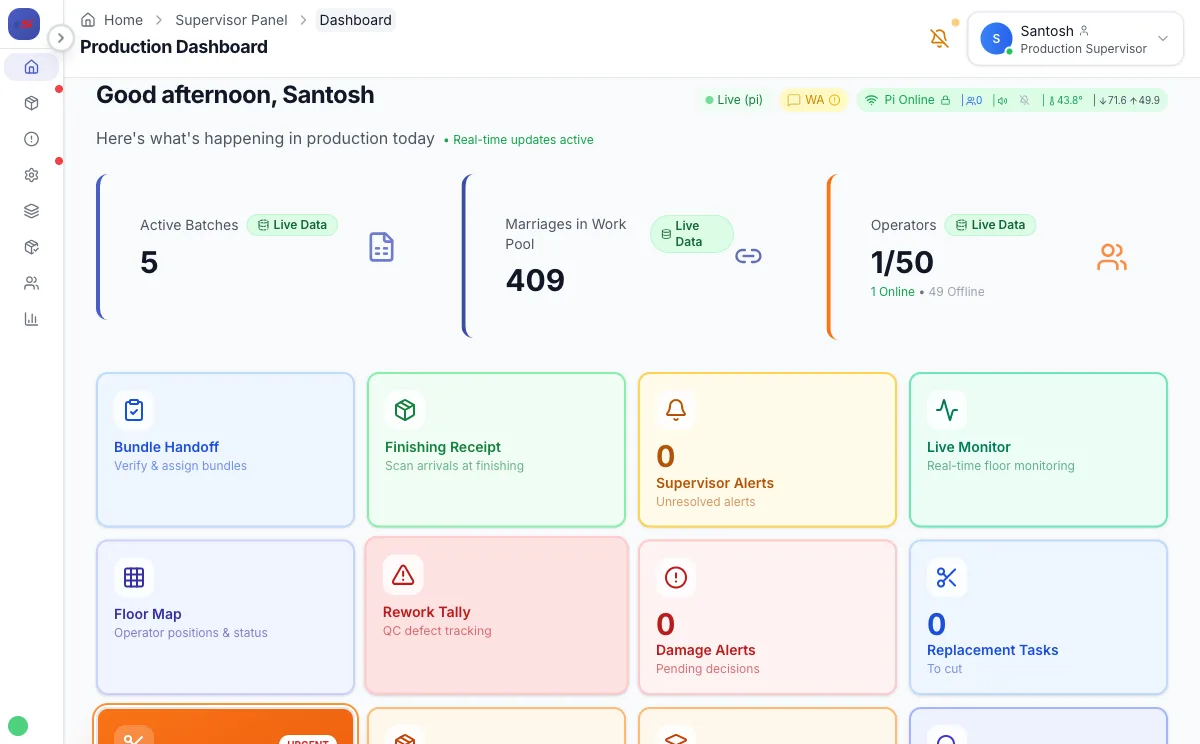
Search for "best ERP for apparel industry" and you will get the same list every time: SAP S/4HANA, Oracle NetSuite, Infor CloudSuite Fashion, WFX, AIMS360, K3 Fashion. Impressive names. Real software. And almost completely useless if you run a CMT sewing factory.
Every one of those lists was written for fashion brands — companies with design teams, retail buyers, PLM requirements, EDI compliance obligations, and collection-based planning cycles. The CMT contractor who sews those brands' garments is not mentioned. The sewing floor where operators scan bundles, piece rates get calculated per stitch operation, and WIP moves in physical bundles from machine to machine — that factory does not appear in any "best ERP for apparel industry" article on the first page of Google.
This article is for that factory. It is an honest comparison of the most-compared apparel ERP systems in 2026, written from the perspective of a sewing contractor who has operated on both sides of the problem: buying software that did not work, and building software that does.
Why "Best ERP for Apparel Industry" Lists Miss the Point for CMT Factories
The confusion starts with the word "apparel." To a fashion brand, apparel ERP software means style management, seasonal collections, size-color matrices, purchase order tracking to suppliers, EDI transactions with retailers, and landed-cost costing for imported goods. To a CMT sewing contractor, apparel ERP means something completely different: which operator sewed which bundle, how many pieces did they complete, what is the piece rate for this operation on this machine type, and is the payment calculation correct for the end of the month.
These are not overlapping requirements. They are different businesses using the same word to describe fundamentally different operational problems.
Most "best ERP for apparel industry" articles are written for fashion brands with design teams, PLM needs, and EDI compliance requirements. A CMT sewing contractor needs operator-level QR scanning, piece-rate payroll, and WIP visibility — none of which appear in NetSuite or SAP demos. When a comparison article lists SAP AFS as the best apparel ERP, it is correct — for a brand with a $500K implementation budget and a full IT team. It is completely wrong for a 60-machine sewing floor where the biggest problem is payment disputes and WIP pile-ups at collar attachment.
The result is a market where CMT factories — which represent the majority of the world's actual garment production — have no reliable guide to apparel ERP software built for their operations. They either overbuy enterprise systems designed for brands, underbuy generic manufacturing ERP that does not understand garment-specific workflows, or continue running on Excel and WhatsApp voice messages. None of these outcomes is acceptable for a factory trying to scale.
The 6 Most-Compared Apparel ERP Systems in 2026
Here is an honest assessment of the systems that dominate "best ERP for apparel industry" searches — what they are actually designed for, and whether a CMT sewing contractor should consider them.
SAP S/4HANA (formerly SAP AFS)
SAP's Apparel and Footwear Solution is the most powerful ERP for apparel manufacturing in existence — if your operation looks like a $500M brand with a global supply chain, a team of SAP consultants, and 18 months for implementation. For a CMT factory, the implementation cost alone ($50,000–$150,000+) exceeds several years of software investment that would produce measurable results. SAP does not have a native concept of piece-rate payment per sewing operation. It does not scan QR bundles at machine stations. Its production module tracks work orders, not bundles moving through a sewing line. It is the best apparel ERP software for the Fortune 500 apparel brands that it was designed for. It is the wrong tool for a 100-machine sewing floor.
Oracle NetSuite
NetSuite is genuinely good at what it does: financial management, inventory, order management, and multi-entity consolidation for growing fashion brands. Its manufacturing module handles basic work orders and BOMs. What it does not handle is the physical reality of a sewing floor — bundle-level tracking, operator-by-operator piece counts, real-time WIP by station, or piece-rate payroll that calculates per operation rather than per finished unit. NetSuite's strength is brand-side business management. The sewing floor is not its concern, and the product reflects that clearly.
WFX (World Fashion Exchange)
WFX is a cloud PLM and supply chain platform built for fashion sourcing teams. It is excellent at tech packs, sample tracking, supplier communication, costing worksheets, and quality inspection at the vendor level. It is not a production floor system. There is no operator scanning, no piece-rate calculation, no real-time WIP dashboard for the sewing line. WFX sits upstream of production — it manages the relationship between the brand and the factory, not the internal operations of the factory itself. If you are the brand, WFX is relevant. If you are the CMT contractor the brand sources from, WFX is your buyer's software, not yours.
Infor CloudSuite Fashion
Infor CloudSuite Fashion handles the style-size-color matrix particularly well, which is a genuine technical challenge in apparel ERP. It covers merchandise planning, allocation, replenishment, and retail-side operations. Its production management capabilities exist but are oriented toward style-level planning rather than floor-level execution. Like SAP and NetSuite, it does not have native QR bundle scanning, operator-level piece tracking, or piece-rate payroll. It is a mid-to-large brand's system, priced and implemented accordingly.
AIMS360
AIMS360 is a well-regarded best apparel ERP option for small-to-mid fashion brands in the wholesale and retail segment. It covers EDI, order management, inventory, and production planning at the style level. It is genuinely more accessible than SAP or Infor. However, like the others, its production module is designed for brand-side purchase order management — tracking orders to CMT vendors, not managing operations inside those vendors' factories. If you are a fashion brand placing orders to CMT factories, AIMS360 is a strong option. If you are the CMT factory receiving those orders, you need something built for your floor.
Scan ERP
Scan ERP is purpose-built for CMT sewing operations. It was designed from the ground up for the factory floor: QR bundle scanning at each machine station, real-time piece count per operator, piece-rate payment calculation per operation with machine-type and skill-level adjustments, biometric attendance integration, and cutting room management with bundle generation. It is not a fashion brand system. It does not handle EDI, PLM, or retail allocation. What it handles — the actual production operations inside a sewing factory — it handles with a level of specificity that no general-purpose apparel manufacturing ERP can match. Setup takes days, not months.
Comparison: 6 Apparel ERP Systems at a Glance
The table below cuts through vendor marketing to show what actually matters for a sewing factory evaluating the best ERP for apparel industry options in 2026.
| System | Target User | Piece-Rate Pay | QR Bundle Scanning | Setup Time | Monthly Cost |
|---|---|---|---|---|---|
| SAP S/4HANA | Large apparel brands | ✗ | ✗ | 12–18 months | $95–$250/user + $50K–$150K setup |
| Oracle NetSuite | Fashion brands, multi-entity | ✗ | ✗ | 3–6 months | $999+/month base + per-user |
| WFX | Brand sourcing teams | ✗ | ✗ | 2–4 months | $500–$2,000/month |
| Infor CloudSuite Fashion | Mid–large fashion brands | ✗ | ✗ | 6–12 months | Enterprise pricing on request |
| AIMS360 | Small–mid fashion brands | ✗ | ✗ | 4–8 weeks | $300–$800/month |
| Scan ERP | CMT sewing contractors | ✓ | ✓ | 1–2 weeks | Flat monthly rate |
What the Best Apparel ERP Must Do for a Sewing Factory
The best ERP for apparel industry — specifically for a CMT contractor — needs to solve five concrete operational problems that no generic manufacturing ERP and no brand-focused fashion system addresses. If a system cannot pass all five tests, it is not a serious candidate for your factory floor.
1. QR Bundle Tracking at the Machine Station
Every bundle in a CMT factory has a physical identity: lot number, article, component, size, color, and bundle number. The ERP for apparel manufacturing must track that bundle through every sewing operation as it moves from station to station — not at the style level, not at the work order level, but at the individual bundle level. This requires QR code scanning at the point of work, not data entry at the end of a shift. Any system that asks supervisors or data entry clerks to log production manually will always have stale, inaccurate WIP data.
2. Piece-Rate Payment Per Operator
Piece-rate payroll is the defining financial workflow of a CMT sewing factory. It is not a simple multiplication of pieces times price. It involves base rates per specific operation (overlock seam vs. single-needle topstitch vs. buttonhole are not the same rate), skill-level adjustments for experienced operators, machine-type complexity factors. The best apparel ERP must calculate all of this automatically from scan data — not require a supervisor to build a payment spreadsheet at month end. Payment disputes are one of the biggest causes of operator turnover in sewing factories. A system that eliminates the dispute eliminates the turnover.
3. Real-Time WIP Visibility by Station and Line
Work-in-progress pile-ups are the most common source of production loss in a sewing floor. They build at convergence points — places in the operation sequence where multiple components must meet before work can proceed, such as where a collar, a body, and a sleeve must all be ready before assembly begins. Apparel ERP software that derives WIP automatically from scan events — showing a live count of bundles at each station, bundles waiting at each convergence point, and the bottleneck operation in real time — gives supervisors the information to intervene before a pile-up stops a line. A dashboard that is updated at shift end tells you what already happened. A live dashboard tells you what to do now.
4. Biometric Attendance Integration
Attendance records in a CMT factory directly affect payment calculations — overtime, late starts, half-days, and absence patterns all feed into the payroll. Apparel manufacturing ERP that pulls attendance data automatically from a biometric device eliminates one of the most dispute-prone manual data entry steps in a sewing factory. Supervisors stop having to manually correlate punch records with production data. The system already knows who was on the floor, when they were there, and how many pieces they completed during that time.
5. Cutting Room Integration
The cutting room is where production begins. Cutting batches define the lot, article, size breakdown, color mix, and component count for everything that will flow through the sewing floor. ERP for apparel manufacturing that integrates the cutting room — generating bundle QR codes at the point of cutting, associating bundles with their cutting batch, and tracking fabric consumption against the cutting plan — gives the production floor a reliable foundation. A sewing floor ERP that starts at the scan station without knowing what the cutting room produced is tracking production in a vacuum.
Total Cost Comparison: What You Actually Pay for Apparel ERP Software
The sticker price of apparel ERP software is rarely the real price. Implementation, training, customization, ongoing support, and per-user fees can multiply the advertised cost by a factor of three to ten by the end of year one. Here is an honest breakdown of what the most-compared systems actually cost a mid-size CMT factory with 60–100 operators.
SAP S/4HANA: The software license alone runs $95–$250 per named user per month. For 60 operators and 5 supervisors, that is $4,000–$16,000 per month before you have touched implementation. Implementation for a mid-size operation typically runs $50,000–$150,000 in consulting fees, not including internal team time. Training takes weeks. Go-live timelines are 12–18 months. Total year-one cost for a factory of this size: $200,000–$400,000. This is not software pricing. It is a capital project.
WFX: Monthly fees range from $500 to $2,000 depending on modules and users. Implementation is 3–6 months and typically requires a dedicated project manager. For a CMT factory, none of the modules WFX charges for — PLM, tech pack management, supplier portal — are relevant to sewing floor operations. You would be paying for features you cannot use while missing the features you need.
Oracle NetSuite: Base platform starts above $999/month. Each manufacturing module is an add-on. Per-user fees apply. Implementation partners charge $150–$250/hour. A realistic year-one total for a 200+ machine CMT factory, if someone could make NetSuite work for that use case (which is not straightforward), would be $80,000–$150,000.
Scan ERP: Flat monthly pricing. No per-user fees that create growth penalties as your operator headcount scales. Setup is measured in days for a factory with under 200 operators. Training is designed for supervisors with no prior ERP experience. The full year-one cost is a fraction of a single month of SAP licensing at comparable scale.
The ROI case for purpose-built apparel manufacturing ERP at a CMT factory is straightforward when you calculate it honestly:
( (payment disputes/month × avg loss per dispute)
+ (hours saved on reporting/month × supervisor hourly rate)
+ (fabric wastage reduction % × monthly fabric cost) )
/ monthly ERP cost
Example: 12 disputes/month × $35 avg loss = $420 + 20 hrs saved × $8/hr = $160 + 2% fabric saving × $8,000 = $160 → total benefit = $740/month. If ERP costs $120/month, ROI = 6.2×
How to Shortlist: 4 Questions That Eliminate 80% of Apparel ERP Software
When evaluating any system claiming to be the best ERP for apparel industry, four questions will eliminate most of the field before you invest time in a full demo. Ask them upfront, in the first conversation, and require live answers rather than follow-up slides.
Question 1: Can it scan a QR bundle and update operator pay in real time? This is the single most discriminating question you can ask. Every enterprise apparel ERP will hedge, redirect, or offer a custom module proposal. A system built for sewing floors should be able to demonstrate this in under 5 minutes — scan a bundle, show the operator's piece count increment, show the payment calculation update. If it cannot, the system was not designed for production floor use.
Question 2: Does piece-rate calculation come out of the box? Not as a customization. Not as an add-on module. Not as a report that a consultant builds for you. The piece-rate calculation — including per-operation rates, skill adjustments, and machine complexity factors — should be a standard feature of any apparel manufacturing ERP for CMT factories. If the vendor says "we can build that," they have never run it in a real sewing factory.
Question 3: Can operators use it on a standard Android phone? The average operator at a CMT sewing factory already owns a smartphone. If the apparel ERP software requires a dedicated hardware terminal, a proprietary scanner, or a per-station device, you are looking at a hardware investment that multiplies your total cost by your station count. A system designed for the factory floor should run on any modern smartphone browser. Ask what the operator physically holds during a scan.
Question 4: Can you go live in under 30 days? Setup timelines are a direct measure of how production-ready the product is. A system that requires a 3-month discovery engagement, a 6-month configuration phase, and a 2-month parallel run was not built for small-to-mid CMT factories. It was built for enterprise procurement cycles. If the vendor cannot get a factory under 150 operators live in under 30 days, the complexity lives in the implementation, not in the software — and you will pay for that complexity in consulting fees indefinitely.
Ask any vendor to show you three things in the first three minutes of a demo: (1) scan a QR bundle, (2) show the operator's piece count update in real time, (3) show the payment auto-calculation. If they cannot do all three in under 3 minutes — without switching screens, calling a product specialist, or saying "let me pull up a different module" — their ERP was not built for a sewing floor. This is not a trick question. For software designed specifically for CMT operations, these are three of the most basic functions. They should be instant to demonstrate.
The Verdict: Best Apparel ERP by Factory Type
There is no single best ERP for apparel industry across all factory types. The right answer depends entirely on what kind of apparel business you operate. The table below gives an honest verdict by factory category.
| Factory Type | Best ERP Option | Why |
|---|---|---|
| Fashion brand with retail, PLM, and EDI needs | NetSuite or AIMS360 | Strong order management, inventory, and financial reporting oriented toward brand operations |
| Large export manufacturer ($50M+ revenue) | SAP S/4HANA or Infor CloudSuite | Scale, multi-currency, global supply chain complexity justify the investment and implementation cost |
| CMT sewing contractor (20–200 machines) | Scan ERP | Purpose-built for QR bundle tracking, piece-rate pay, real-time WIP — the only system in this comparison designed specifically for CMT operations |
| Small shop (20–50 machines, growing) | Scan ERP | Fast setup, flat pricing without per-user penalties, no implementation consultant required — scales with the operation as machine count grows |
The pattern is consistent: the enterprise systems that dominate "best ERP for apparel industry" searches are correct answers for enterprise apparel brands. They are not correct answers for CMT sewing contractors, regardless of size. A 300-machine CMT factory and a 30-machine CMT factory have more in common with each other operationally than either has with a fashion brand using SAP or NetSuite.
Why the Right Apparel ERP Changes Factory Economics
The tangible outcomes of implementing the right best apparel ERP for a CMT factory are measurable within the first 60 days. Payment disputes drop when operators can see their own piece count in real time. WIP pile-ups surface earlier when supervisors have a live dashboard rather than end-of-shift reports. Cutting waste decreases when the ERP connects bundle generation to fabric allocation and tracks yield per lot. Operator retention improves when payment is accurate, transparent, and paid without argument.
These are not marketing claims. They are the specific problems that led to Scan ERP being built in the first place — inside a running sewing factory, against real production conditions, because every other system in the "best ERP for apparel industry" conversation was built for someone else's problems.
The right question is not which apparel ERP software has the most features or the largest customer list. The right question is which system was built for your specific operations. For a CMT sewing contractor, that means QR bundle tracking, piece-rate payroll, real-time WIP, and a setup timeline measured in days rather than months. Most of the systems on these comparison lists cannot deliver any of those four things. One of them can.
See the Best Apparel ERP for CMT Factories in Action
20-minute live demo. QR bundle scan, real-time piece count, payment calculation — all three in the first 5 minutes. No slides.
Book a Demo on WhatsApp →What does Scan ERP cost?
Scan ERP costs $4 per machine per month, or $0.005 per finished piece tracked, whichever bills lower that month. A 50-machine CMT factory pays about $200 a month. There is no minimum, no per-user fee and no contract. Hardware is $1,500 to $3,000 one-time and bought separately.