
Task Management App for Garment Manufacturing: Why Generic Tools Fail and What Works Instead
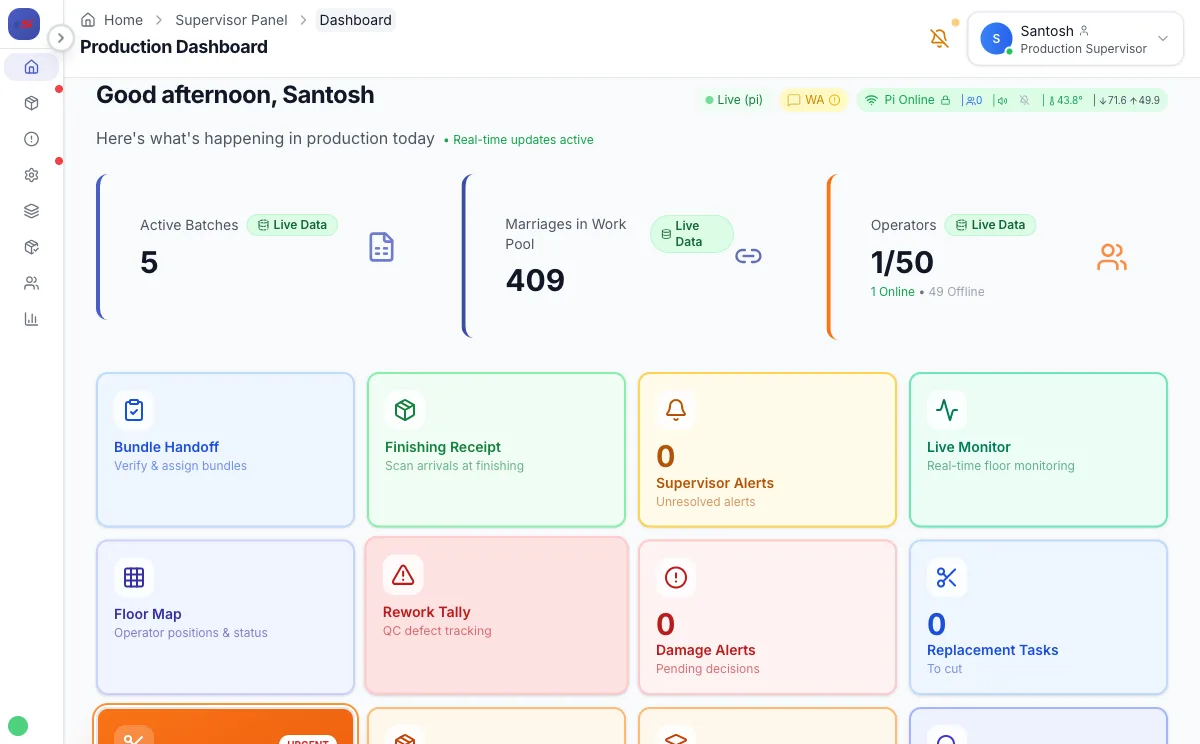
When garment factory managers search for a "task management app," they usually mean one of two very different things: a tool to track orders and sampling milestones (office-level), or a system to manage work on the sewing floor (production-level). Most search results point to Trello, Asana, and Monday.com for the first use case. None of them work for the second.
This guide explains exactly why generic task management apps cannot handle garment floor operations — and what production-specific tools do differently.
The Two Types of Task Management in a Garment Factory
Before evaluating any tool, it helps to separate the two distinct management layers in a garment business:
Level 1: Order and Sampling Pipeline (Office Tasks)
These are the tasks that management and merchandisers handle: receiving a purchase order, creating a sampling critical path, tracking buyer approvals, scheduling fabric bookings, managing shipment milestones. The "task" here is a document to submit, a call to make, an approval to get. It has a due date, an owner, and a status (pending / in progress / done).
Generic project management tools — Zoho Projects, Trello, Asana, Wrike — handle this layer adequately. Zoho Projects is particularly popular in the textile industry for its affordability and integration with Zoho CRM and Books. Wrike is used in larger operations for resource management and automated workflows.
Level 2: Sewing Floor Production (Operational Tasks)
This is where generic task management completely breaks down. A "task" on the garment floor is: Operator Sunita completes 85 pieces of collar attach on Bundle B-047, at 0.54 SAM per piece, on Overlock Machine 14, in 47 minutes. That task generates:
- A piece-rate earning of 85 × ₹2.10 = ₹178.50
- An efficiency record: (85 × 0.54) ÷ 47 = 97.6%
- A WIP update: Bundle B-047 advances from collar attach to collar join
- A quality checkpoint: any defects logged against this operation
Trello has no data model for any of this. A Trello card for "Bundle B-047 collar attach" cannot calculate piece-rate, cannot track which operator claimed it, cannot show it on a real-time WIP board alongside 200 other concurrent bundles, and cannot automatically unlock the next operation in the sequence.
What Production Task Management Needs in a Garment Factory
The requirements for garment floor task management are specific:
1. Bundle-Level Work Assignment
Every physical bundle needs a unique identity (QR code). The system generates a work queue: which operator should take which bundle for which operation, based on their machine type and current workload. Operators claim work by scanning — no supervisor intervention needed for routine assignments.
2. Real-Time WIP Visibility
At any moment, a supervisor should see the count of bundles at each operation stage. If 40 bundles are queued at collar join and 3 operators are idle at sleeve set, that imbalance is visible immediately — not at end of shift. For a deeper look at how WIP tracking works on the floor, see the WIP tracking guide for garment factories.
3. Automatic Piece-Rate Calculation
Every completed scan generates an earnings entry: pieces × operation piece rate. This runs automatically from the scan data. No tally sheets, no month-end manual calculation, no disputes about what was done when.
4. Hourly Target vs Actual
The single most impactful feature for efficiency improvement is an hourly board — visible on a shared screen on the floor — showing "Target: 48 | Actual: 41" for each line. Operators and supervisors self-correct when they can see the gap in real time. End-of-day reports tell you what went wrong; hourly targets give you time to fix it.
5. Works Without Reliable Internet
Factory floors have dead zones. Any production management app must queue scans locally when offline and sync when connectivity returns. A scan that fails loses production data and creates WIP gaps that take hours to reconcile.
Tool Comparison: What Exists in 2026
| Tool | Type | Floor QR Tracking | Piece-Rate Calc | Best Use |
|---|---|---|---|---|
| Trello / Asana / Monday | Generic task management | No | No | Order pipeline, office tasks |
| Zoho Projects | General task/project mgmt | No | No | Sampling critical path, admin workflows |
| WFX Smart Factory | Garment MES | Yes | Partial | Mid-to-large export factories |
| TrackIT (3-Tree) | Supply chain tracking | Partial | No | Order and vendor tracking |
| Scan ERP | Garment floor MES | Yes | Yes (automatic) | CMT factories, 50–300 operators |
| Coats Digital FastReact | Production planning | No (planning only) | No | Capacity planning, order scheduling |
Why Garment Floor Task Management Is Harder Than It Looks
The fundamental challenge is that a garment operation is not a "task" in the project management sense. It is a combination of: a physical object (bundle), a person (operator), a machine (specific type), a quantity (pieces), a time period, and a quality outcome. All five dimensions need to be captured simultaneously at the moment of completion — not entered by an administrator afterward.
This is why QR scanning is the right interface for the factory floor. The operator does not type anything. They complete the work, scan the bundle out, and everything is recorded: who, what, when, how many. The task management happens through physical scan events, not through someone updating a digital board.
For a detailed look at how this works in practice — from cutting room bundle generation to finishing — see the QR code production tracking guide.
The Practical Recommendation
Most garment factories need two systems, not one:
- For office and order management: Zoho Projects, Trello, or even a well-structured Google Sheet. Cheap, accessible, familiar to office staff.
- For factory floor production management: A purpose-built garment MES with QR scanning, WIP tracking, and piece-rate payroll. This is a fundamentally different tool for a fundamentally different workflow.
Trying to use one tool for both — or using a generic task manager for the floor — results in either data that nobody trusts or adoption that collapses within weeks.
For a full overview of how production KPIs connect to floor management, see the garment factory KPI metrics guide.
See How Floor Task Management Works in Practice
20-minute demo — live bundle tracking, work assignment, and real-time WIP board on your factory's actual lot numbers.
Book a Free Demo →