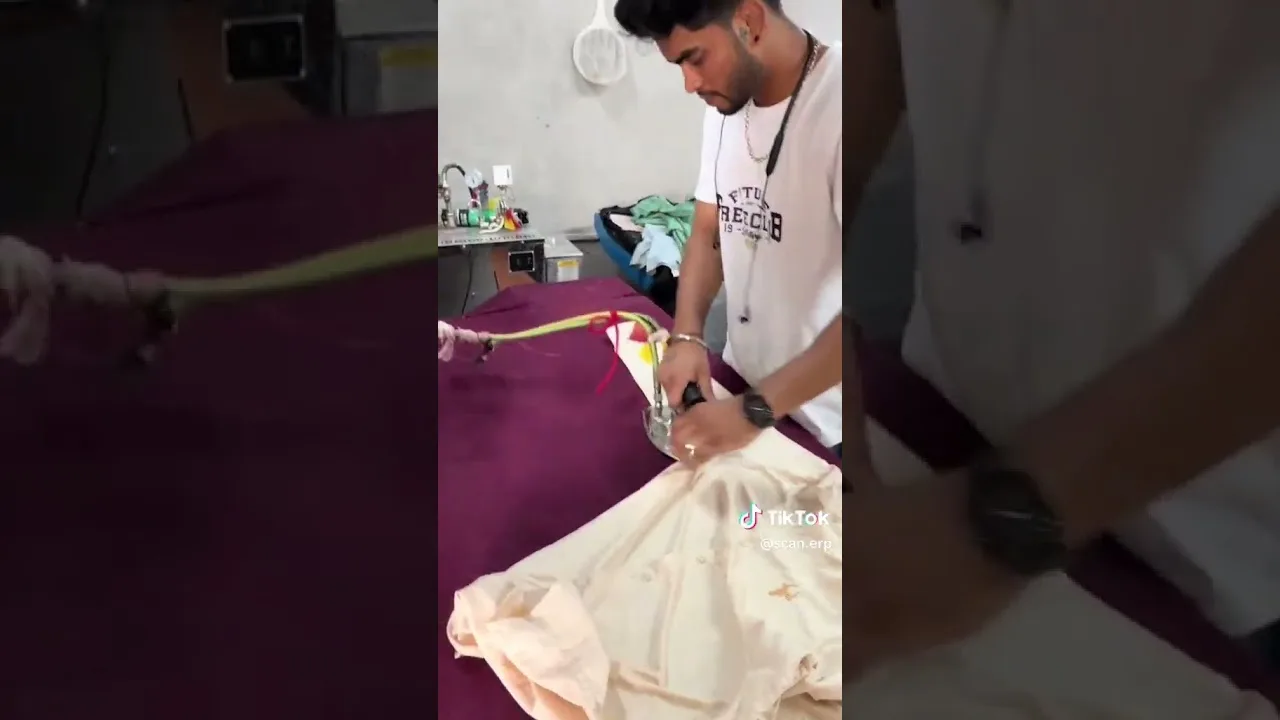
Full garment factory automation — not just ERP
Scan ERP — Garment Manufacturing ERP
Stop losing pieces. Stop payment fights. Manage unskilled labor automatically — without chaos.
20-minute call · We show your factory's flow · Calculate your factory's monthly loss · Why paper bundle tickets fail
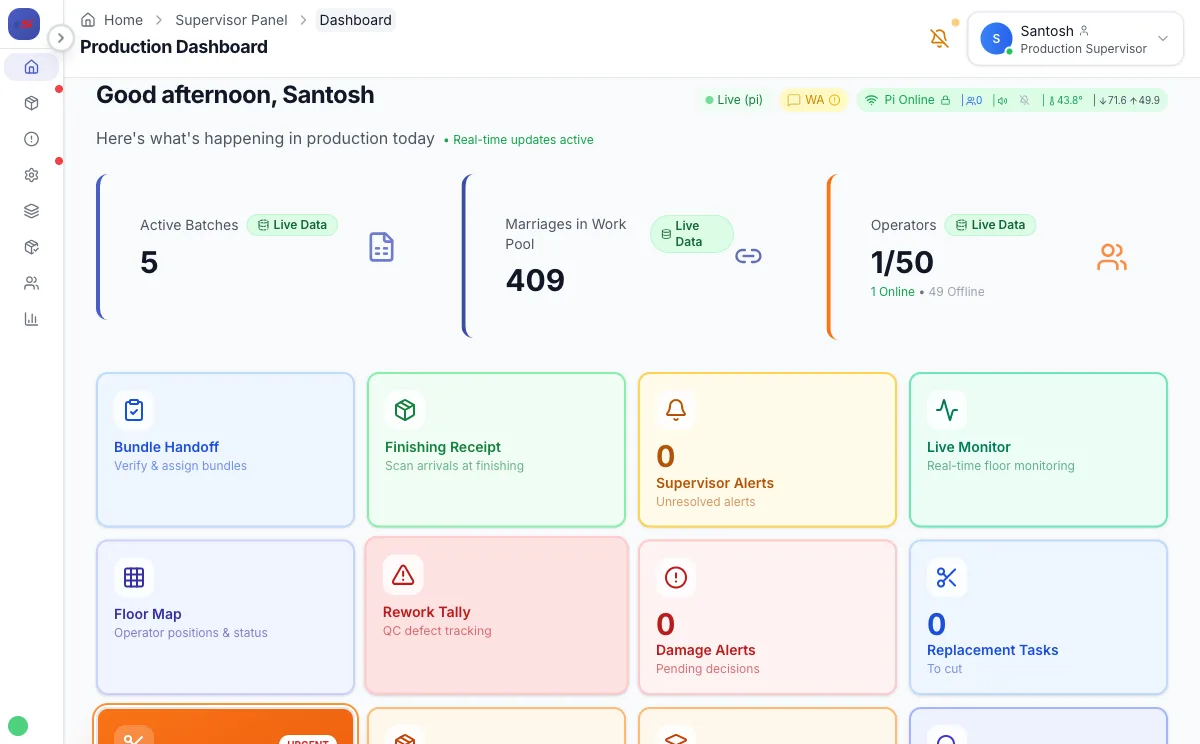
55 Seconds to See How Your Factory Could Run
Watch a real factory floor — not a simulation. See QR scanning, instant payment calculation, and live production dashboards in action.
Your Garment Factory Is Losing Money Right Now — Here's How
If you recognize even one of these problems, your garment factory is silently losing revenue to invisible WIP gaps, line bottlenecks, and payment disputes. Garment factory automation closes these gaps — the documented 8–15% productivity lift applies to RMG, CMT, and integrated sewing factories alike.
"Where did 200 pieces go?"
Bundles vanish between cutting and sewing with zero WIP tracking. Nobody knows which operator has them. By the time you find out, the delivery deadline is missed and the buyer audit fails.
"This isn't what I earned"
Your best operators threaten to leave because manual piece counting always has "errors." Supervisors spend 3 days every month reconciling payments instead of managing production.
"Why is Line 3 stuck?"
A sewing line has been stuck for 2 hours — but you only discover it at end of day. No real-time monitoring, no line balancing alerts, no way to redistribute work before it becomes a 500-piece bottleneck.
"My operators can barely read."
Most CMT operators are first-generation factory workers — many illiterate, few speaking English. Training them on traditional ERP screens is impossible. Scan ERP handles unskilled labor automatically: visual QR scans replace forms, voice PA announces work in their language, supervisors manage everything from WhatsApp. Garment factory automation that works for the workforce you actually have.
From scaling a medical-tech platform to 200,000+ users — to revolutionizing garment factory automation.
I'm Santosh Rijal. I'm an MBBS doctor, a serial entrepreneur, and the owner of Trishakti Apparel — a 100-machine garment factory in Gaindakot, Nepal running RMG and CMT operations.
Before garments, I co-founded Medicos International, a Nepal tech startup behind MedicosPDF — a learning platform now serving 200,000+ medical students globally (93% outside Nepal) with a 4.7/5 rating. Building software that scales worldwide taught me one lesson: digital tools succeed when they meet users where they are, in the language they speak, on the device they already own.
When I bought the garment factory, every off-the-shelf ERP I evaluated violated that lesson. They were built for $50K+ fashion brands or for accounting departments — not for the sewing floor where unskilled operators (most first-generation factory workers, many illiterate) actually do the work. So I built Scan ERP myself — a complete garment factory automation platform, not just an ERP. Same discipline a doctor uses: find the bleeding point, fix it, measure outcomes. Same scale discipline I learned with MedicosPDF: works on a $50 Android phone, in any language, no IT team required.
Scan ERP has tracked 1,400,000+ pieces through RMG and CMT lines in my own factory since 2024. Every feature exists because I needed it on my own floor first. The pricing — $5/machine or $0.001/piece, whichever is cheaper — exists because I refused to charge other factory owners more than my own factory could afford.
"We don't want to earn much. When your factory earns, that's our satisfaction. That's the mission — revolutionize garment factory automation from the factory floor side, not the vendor side."
Reach me directly on WhatsApp +977 9863618347 · or read the deeper story at how I built this.
Factory Owners Who Made the Switch
Real results from garment factories — RMG, CMT, and integrated — that were running on Excel and WhatsApp before garment factory automation.
"We used to spend 3 days every month reconciling payments. Operators were always arguing. After Scan ERP, everything is calculated automatically on every scan. No more fights. My supervisor can finally focus on production."
"I was losing 200–300 pieces every week and didn't know where. Within the first week of using Scan ERP, I could see exactly which operator had which bundle. We recovered ₹40,000 in the first month just from that."
"My operators are not tech people. I was worried they wouldn't use it. But scanning a QR code is easier than using WhatsApp — and they already know WhatsApp. Everyone was scanning from day one."
From Paper Bundles to Real-Time Tracking in 4 Steps — No IT Team Required
Most factories go live within 2 weeks. No servers to install, no IT department needed. Your operators' own phones become the Industry 4.0 tracking system.
Real-time production monitor — designed for garment factory floor TVs
5 Core Modules That Run Garment Factory Automation
QR bundle tracking, automatic piece-rate, live WIP, cut & sew management, dispatch traceability — the operational backbone of a modern garment factory.
Fabric & Accessory Inventory
- Dual-unit tracking (meters and kg), immutable stock ledger with full audit trail
- Auto-deduction on cutting — transaction-safe with instant roll-by-roll breakdown
- Low stock alerts with velocity calculation: "7 days until stock-out" based on last 30 days
- Size-aware consumption analysis from Optitex marker data, GSM analysis, and aging reports
Cut & Sew Management — Cutting Room to Assembly
- Multi-size, multi-color cutting sheets with auto bundle generation and QR labels
- Bundle handoff: scan bundles → scan operator badge → handoff confirmed. Zero-paperwork physical transfer
- Marriage tracking — ensures all components (Front, Back, Sleeve, Collar) converge before assembly
- Visual template builder with drag-drop dependency chains that auto-unlock operations
Dispatch, Compliance & Supply Chain Traceability
- SAC receipts with A/B quality grading, atomic numbering (SAC-2082-0001), and QR labels
- Challan management with picking lists, packing lists, and printed dispatch documents
- Lot pipeline ledger: balance-sheet view of CUT → RECEIVED → DISPATCHED with deficit and surplus detection per lot
- Every garment piece traced: fabric roll → cutting → operator → machine → dispatch
Quality Control & Damage Management
- Damage reports with photo evidence, severity classification, and payment hold rules
- Bundle splitting: damaged pieces separated into repair bundles with 15% repair bonus
- B-grade inventory with defect-type tracking (stain, tear, size issue, stitching defect)
- Finishing receipt scanner: screen turns green/red visible from 5 meters, auto-announces over the factory PA
Biometric Attendance & Salary
- ZKTeco fingerprint integration — auto check-in/out with ADMS protocol
- Late detection (15-min grace), overtime (1.5x after 8 hours), half-day rules
- Full attendance bonus (Rs 500 for zero absent/late), 3 free late days per month
- Monthly salary: piece-rate + attendance + overtime + bonuses - deductions = net payable
What's Scan ERP worth to your factory?
Pick your country, adjust the sliders. See your monthly savings, annual returns, and payback period.
Why Factory Owners Choose Scan ERP Over Other Garment ERPs
The only garment factory automation platform built specifically for small and mid-size garment factories — RMG factories in Bangladesh, CMT factories in India and Vietnam, integrated units in Ethiopia and Pakistan — factories that need results in weeks, not a 6-month implementation project.
Generic & Enterprise ERPs
- 6-12 month implementation timeline
- $50,000+ license and consulting fees
- Designed for any industry — not garment-specific
- No bundle-level QR tracking or WIP visibility
- No piece-rate payment or operator productivity tracking
- Requires IT team and infrastructure to maintain
- No factory-floor edge cache for WiFi blips
Scan ERP
- Go live in 2 weeks — not months
- Affordable garment factory automation for 20–500 operator RMG / CMT / integrated factories
- Built only for garment manufacturing — smart factory ready
- QR tracking + real-time WIP + line efficiency dashboards
- Automated piece-rate with skill & machine multipliers
- No IT team needed — cloud-based, works on any phone
- Raspberry Pi edge cache keeps the floor running through WiFi blips
What You Won't Find in Any Other Garment ERP
Component Marriage Tracking
Front, back, sleeves and collar each get their own bundle, then matched up before stitching starts. If one part falls short, you see it the same day — not after dispatch.
5-Layer Auto-Recovery
A bundle gets stuck mid-line? Five backup systems quietly clear it — usually before the operator even notices. Your supervisor never wastes a shift unblocking work the floor should have flowed past.
Smart Payment Engine
Not flat piece rates. The system adjusts for machine type, operator skill, quality, speed bonus, overtime and advances on every scan — so monthly payroll is already done by month-end.
Floor PA That Cuts Through Noise
Live announcements call out work completed, earnings hit, and shift welcomes — tuned to be heard over running machines without anyone stopping work. Currently Nepali, more languages rolling out.
Supervisors Run the Floor From WhatsApp
Ask the system anything by message — stock levels, lot progress, today's production, an operator's earnings. Daily earnings land at 6 PM, attendance at 10 AM. No new app to open.
Color-Locked Operator Flow
Operators stay on the same color through the shift — no constant thread changes, no setup churn between bundles. Less time fiddling with the machine means more pieces per hour.
Drag-and-Drop Kanban Planner
One board, eight stages from sampling to dispatched. Drag lots between stages with rules that stop accidental skips — no lot ever goes from Planned to Dispatched by mistake.
Bundle Forensic Search
Type any bundle number and see its full story: every operation, every operator, every machine, time, earnings, current location. Trace a piece in five seconds when a buyer audit asks.
Garment Factory ERP Screenshots
Real screenshots from a live ERP system for garment factory environments — not mockups.
Supervisor dashboard with real-time production pulse, bottleneck detection, and quick actions
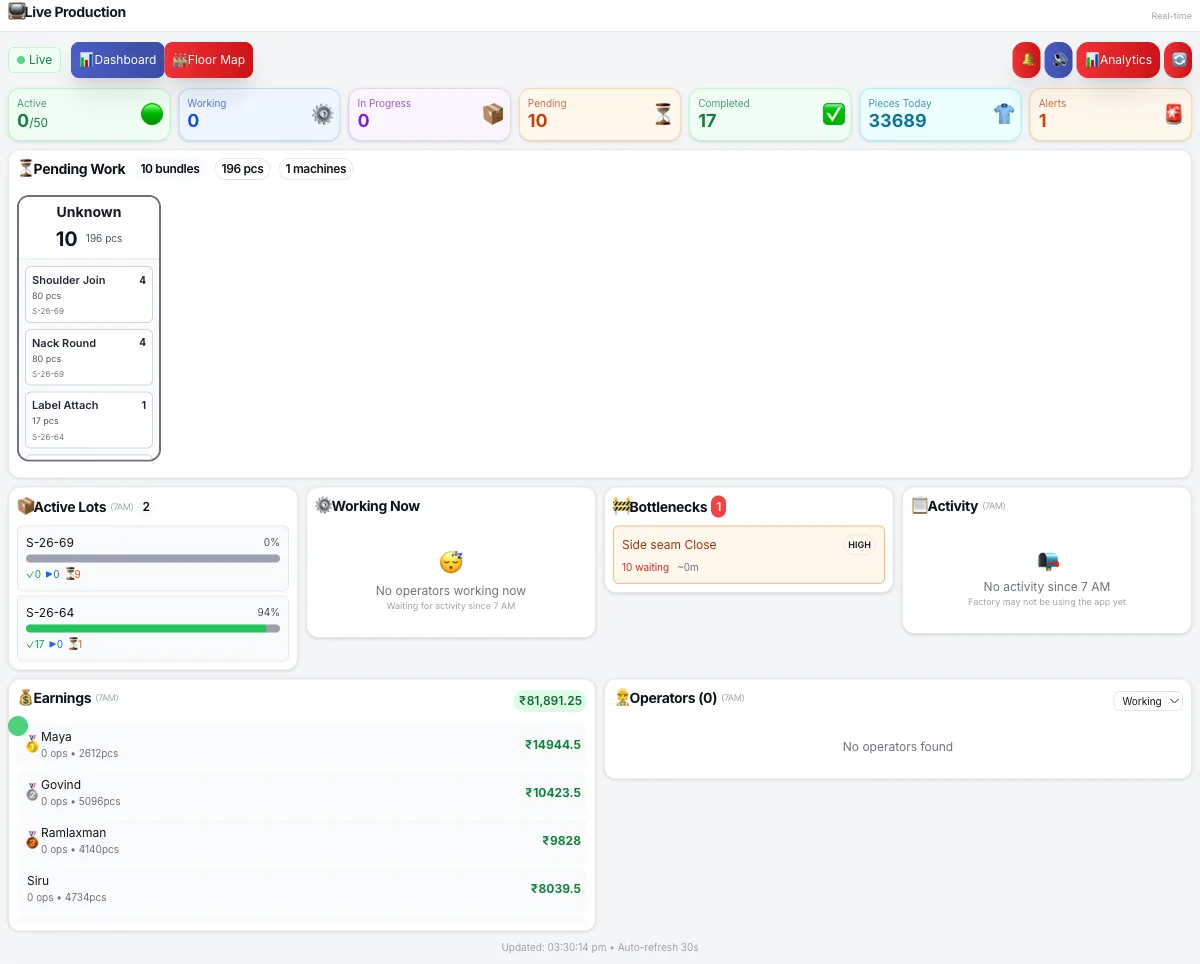
TV-optimized live monitor showing active operators, bottlenecks, and earnings leaderboard
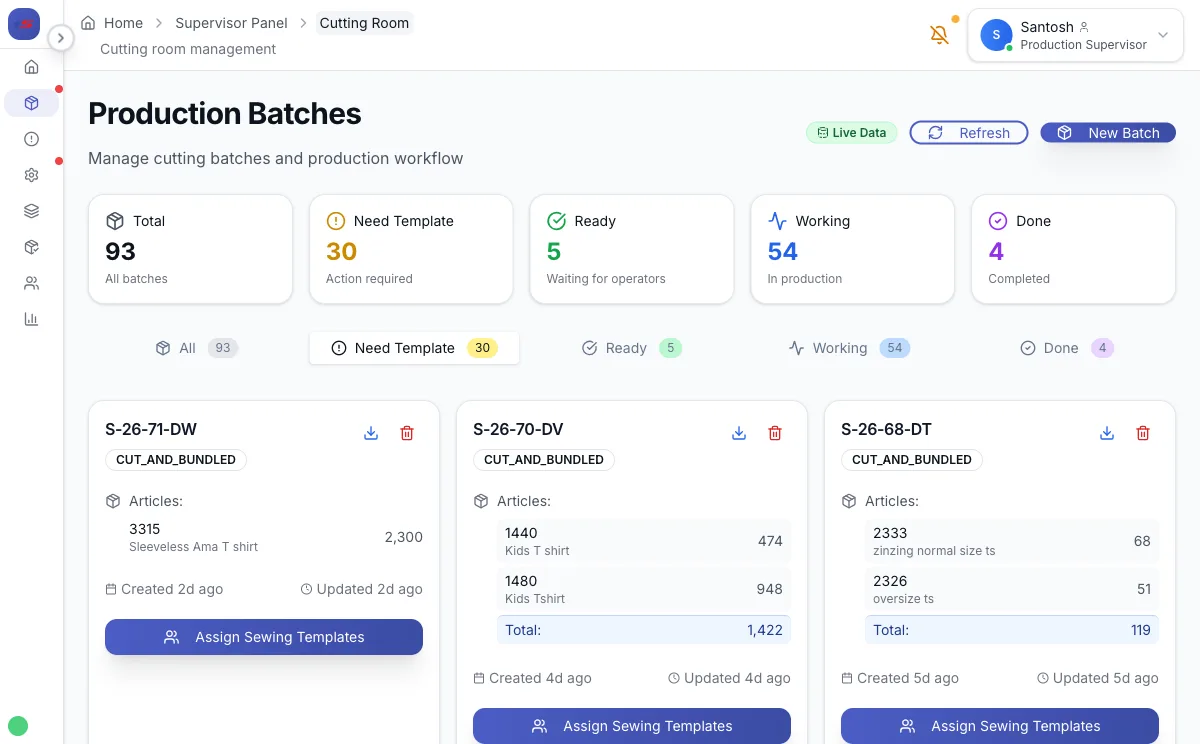
Production batch management with status tracking across the entire manufacturing pipeline
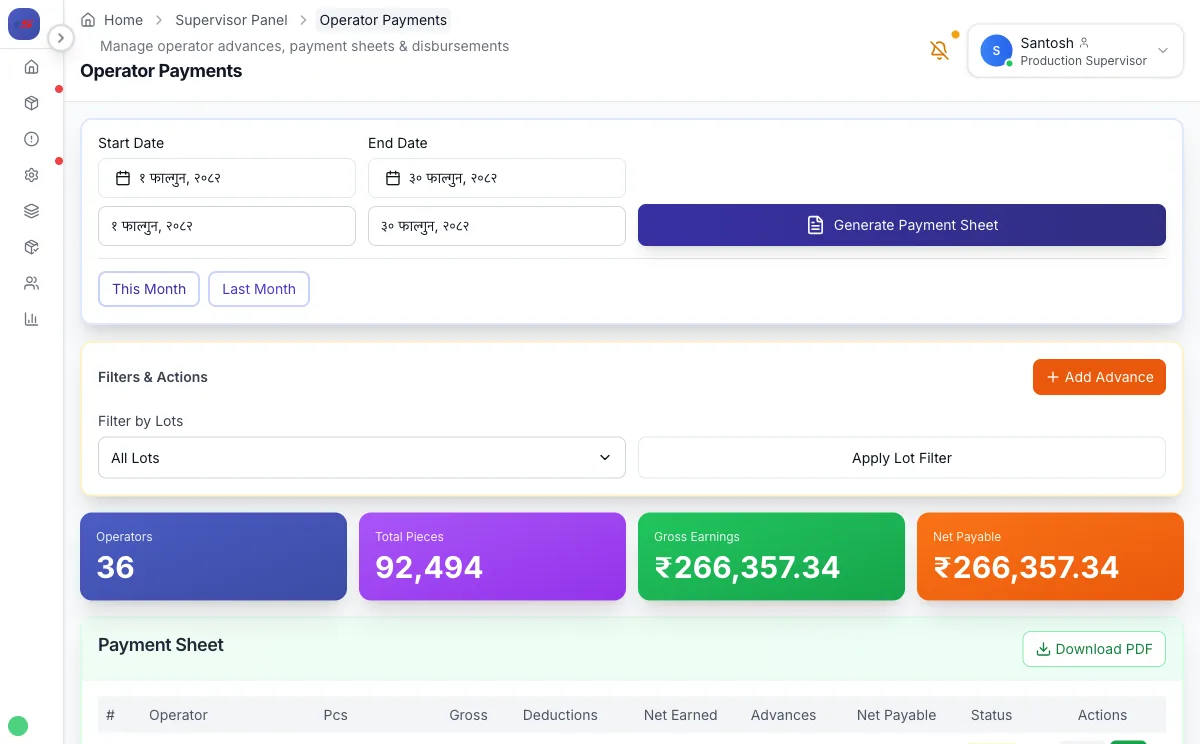
Automated payment sheet with piece counts, gross earnings, deductions, and advances
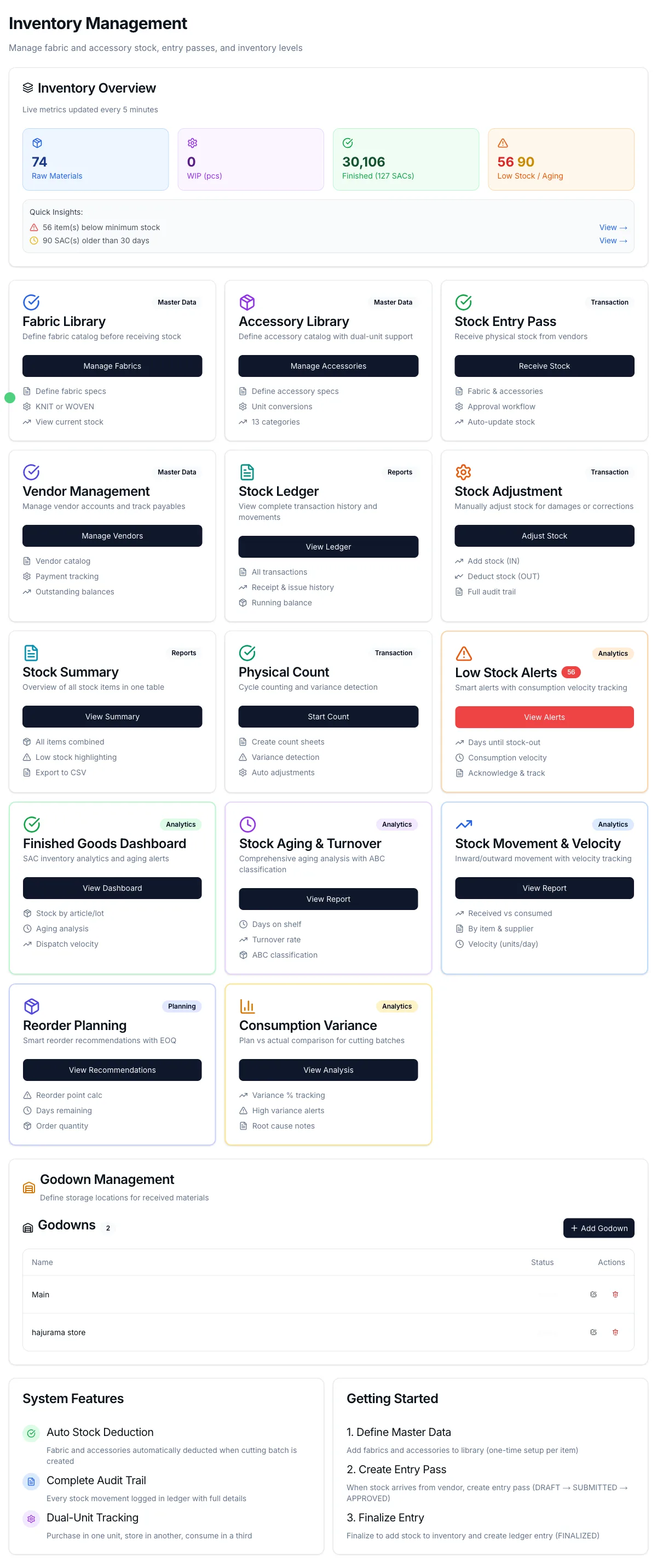
Comprehensive inventory with fabric library, stock ledger, aging analysis, and reorder planning
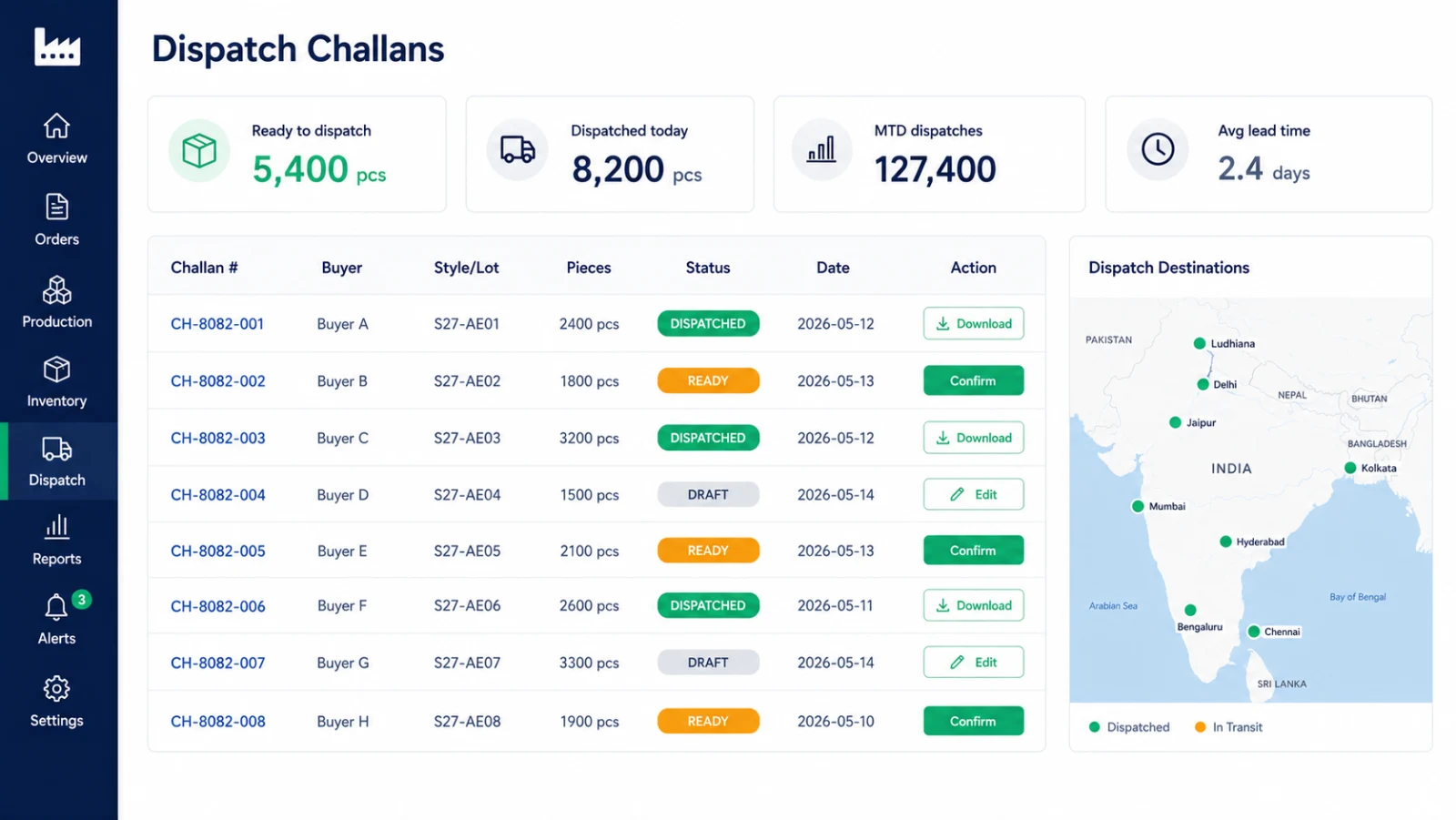
Finished goods tracking with SAC receipts, A/B grade classification, and dispatch management
Garment Factory Automation Pricing
A 100-machine factory loses $3,000–$8,000/month to idle time, payment disputes, and missing pieces. Scan ERP starts at $39/month — pays for itself in the first week.
- All 12 modules — no feature gating
- Unlimited operators, supervisors, admins
- QR bundle tracking + auto piece-rate + live WIP
- 30-day free trial — BYOD only, no card, no commitment
- No setup fees, no per-user fees, no contract
- Hardware (Pi, biometric, printer) ~$1,500–$3,000 one-time — buy from us or anywhere
- Cancel anytime — full data export
Frequently Asked Questions About Garment Factory Management Systems
Answers to what garment factory owners in India, Bangladesh, Vietnam, and worldwide ask before choosing a garment factory ERP system.
What does Scan ERP cost for my garment factory?
Two pricing models — you pay whichever bills lower each month: $5/machine/month or $0.001/piece tracked. Real examples: 30-machine CMT = $39/month, 100-machine factory at 3K pcs/day = $78/month, 500-machine RMG = $1,300/month. Hardware (Pi, biometric, printer) ~$1,500–$3,000 one-time, buy from us or anywhere. No per-user fees, no minimum, no cap. See full pricing & calculator.
Can Scan ERP handle unskilled, low-literacy operators?
Yes — this is core to the design. Most CMT operators are first-generation factory workers, many illiterate, few speaking English. Scan ERP uses visual QR scans instead of forms (operators just point their phone at the bundle ticket), voice PA announcements in their own language, color-coded screens, and supervisor-driven WhatsApp commands. Operators are productive on day one. Garment factory automation works for the workforce you actually have, not the workforce ERP vendors imagine.
What is the best ERP for apparel industry and garment manufacturing?
The best ERP for the apparel industry depends on your factory size. For large enterprises, SAP S/4HANA, Oracle NetSuite, WFX, and Infor CloudSuite Fashion are popular — but cost $50,000–$150,000+ with 6-12 month implementations. For small to mid-size garment factories (20-500 operators, RMG or CMT), Scan ERP is purpose-built garment factory automation software with QR-based bundle tracking, automated piece-rate payments, and real-time WIP dashboards — going live in 2 weeks instead of months.
How does QR-based production tracking work on the garment factory floor?
Each bundle gets a unique QR code printed at cutting using a TSC thermal printer. Operators scan the QR with their phone to start and complete work. The system records operator, operation, time, and calculates payment instantly — with 95-99% scan accuracy. It's like scanning a UPI QR code — your operators already know how. The system provides real-time WIP tracking, sewing line efficiency, and production monitoring on factory floor TV displays.
Does Scan ERP work as a smart factory / Industry 4.0 solution?
Yes. Scan ERP is an Industry 4.0 smart factory solution with IoT hardware integration: Raspberry Pi for edge computing, QR-based digital tracking, biometric attendance, factory PA announcements, WhatsApp automation, and real-time production dashboards on factory floor TVs. It gives you smart factory capabilities without the $50,000+ price tag of enterprise garment ERPs.
How does Scan ERP help with sewing line efficiency and line balancing?
Scan ERP monitors operator productivity and sewing line output in real-time. When a line has a bottleneck — like an overlock operation stuck for 2+ hours — the system detects it automatically within 30 seconds. Supervisors see line efficiency dashboards, operator productivity rankings, and can redistribute work before delays cascade. This real-time line balancing reduces WIP buildup and improves daily output.
Is Scan ERP available for garment factories in India, Bangladesh, Vietnam?
Yes. Scan ERP is cloud-based and works for garment and RMG factories worldwide — India (Tirupur, Noida, Bengaluru), Bangladesh (Dhaka, Chittagong), Vietnam (Ho Chi Minh, Hanoi), USA, Sri Lanka, Pakistan, Cambodia, Ethiopia, and all major garment hubs. It deploys remotely in minutes with no local servers. Interface supports English and Nepali, with Hindi and Bengali planned.
Our factory has unreliable internet. Will a cloud ERP work?
A Raspberry Pi on the factory floor runs an edge cache — it holds a live mirror of work pools and operator diaries on your LAN. When the WiFi drops for a few minutes, supervisor stations keep reading work data from the Pi instead of going dark. Long WAN outages still need internet for full sync. The Pi heartbeats every 30 seconds; if it falls silent, Cloud Functions take over within 2 minutes. Built for the messy infrastructure real CMT factories actually run on — not the perfect-WiFi assumption that most cloud ERPs ship with.
How does piece-rate payment calculation work for garment operators?
Scan ERP handles complex piece-rate structures automatically: base rate × operator skill level (novice to expert) × machine complexity (overlock, flatlock, buttonhole, kansai). It auto-calculates quality bonuses (for 90+ scores), speed bonuses (10%+ faster), overtime (1.5x after 8 hours), advance deductions, and generates monthly payment sheets ready for payroll. Every calculation has a buyer-ready audit trail.
Does Scan ERP provide supply chain traceability for buyer audits?
Yes. Scan ERP tracks the complete journey of every garment piece — from raw fabric receipt, through cutting, to which specific operator sewed which component, when, on which machine. This creates a buyer-ready audit trail and supply chain traceability documentation that meets international compliance standards. Quality grading (A/B classification) and dispatch documentation with challan numbers are built in.
How is Scan ERP different from other garment ERP and MES software?
Most garment ERPs focus on either production planning for large factories or shop-floor monitoring with expensive proprietary hardware. Scan ERP combines both in one system: QR-based tracking, piece-rate payments, WIP dashboards, AND factory hardware integration — all for a fraction of the cost. Operators use their own phones, no RFID tags needed. We work with factories as small as 20 operators. A Raspberry Pi edge cache on the factory LAN absorbs WiFi blips that would freeze a cloud-only ERP.
What's the pricing for Scan ERP garment factory automation?
Two pricing models — you pay whichever bills lower each month: $5 per machine per month OR $0.001 per finished piece tracked. No minimum. No cap. No per-user fees. Real examples: 30-machine CMT factory = $39/month. 100-machine factory tracking 3,000 pcs/day = $78/month. 500-machine RMG factory at 50,000 pcs/day = $1,300/month. Software only — hardware (Pi cache, ZKTeco biometric, TSC label printer, factory TVs) is ~$1,500–$3,000 one-time and you can buy from us or any vendor. 30-day free trial, no card, cancel anytime. See full pricing with interactive calculator.
Field guides from a working CMT factory
Practical guides on bundle tracking, piece-rate math, compliance, and what actually works on a sewing floor. Written from operator side, not vendor side.
SAM & SMV Calculation: The Complete Guide
Stopwatch method, performance rating, allowance percentages — with real factory examples for T-shirt, polo, formal shirt, trouser.
Read guide →How QR Code Production Tracking Works on a Real Floor
Bundle journey from cutting to pay slip. What breaks, why $50 phones beat $200 scanners, and the 3-decoder engine that hits 99% accuracy.
Read guide →Piece-Rate Payment Calculation Without Spreadsheets
Skill multipliers, machine complexity bonuses, quality thresholds, overtime rules. Why your operators are unhappy, and what actually fixes it.
Read guide →The Bundle System Explained Without Textbook Jargon
Why progressive bundles still dominate. Anatomy of a bundle ID. Where bundle systems break and how to recover lost pieces.
Read guide →Digital Product Passport: Factory-Side Readiness Guide
EU mandatory March 2027. What data your factory must capture, what brands will demand, and how QR bundle logs auto-generate audit-grade DPP data.
Read guide →Garment ERP for Bangladesh RMG Factories
Internet drops 3-5×/day, $50 phones as the operator device, BGMEA compliance — what factory tech needs to handle in Dhaka and Chittagong.
Read guide →Real-Time WIP Tracking — Detect Bottlenecks in 30 Seconds
How live WIP visibility eliminates the daily 9 AM bundle count, surfaces line bottlenecks before they cost a shift, and runs on cheap Android phones.
Read guide →Complete Garment Factory ERP System Guide
Build vs buy, cloud vs on-prem, SAP vs Centric vs FastReact vs lean alternatives. What's worth the money for a 50-1000 operator factory.
Read guide →Use our garment calculators in your own code
8 production-tested calculators we use every day in our Nepal CMT factory — now published as standalone npm and PyPI packages. No signup. npm install or pip install and you have the formula.
Tell Us About Your Factory — We'll Show You Exactly How It Works
20-minute WhatsApp call. We use your actual lots, machine count, and production flow — not a generic demo. See why garment factory owners choose Scan ERP as their garment factory management software and garment factory management system — and know if it fits before the call ends.
+977-9863618347 — reply within 2 hours
Serving garment factories worldwide