
Garment Manufacturing Software: What Actually Works in 2026
The garment manufacturing software market was valued at $3.5 billion in 2024 and is projected to reach $7.9 billion by 2035 — growing at 7.78% annually (Fortune Business Insights, 2025). That growth has attracted hundreds of vendors. Most of them will not survive five years. More importantly, most of them are not built for what actually happens on a factory floor.
I run a sewing factory in Nepal. Over the past four years I have implemented, abandoned, and eventually built my own garment manufacturing software after failing to find something that handled what my floor actually needed: QR bundle tracking, automatic piece-rate payroll, and real-time sewing line efficiency — all running on cheap Android tablets without reliable internet.
This guide covers what garment manufacturing software needs to do, which categories of vendors exist in 2026, and how to evaluate them without being taken in by a polished demo.
What Garment Manufacturing Software Actually Needs to Do
Generic ERP systems — SAP, Oracle, Microsoft Dynamics — treat manufacturing as inventory movement. A raw material comes in, a finished product goes out. That abstraction works for discrete manufacturing. It does not work for garment production.
A garment factory produces value through operations performed on bundles by operators on specific machines. A bundle of 10 FRONT panels goes through 15 sewing stations before it becomes part of a finished shirt. Each station needs to be logged. Each operator's output needs to be recorded for piece-rate calculation. Each bundle's location needs to be known in real time to identify bottlenecks.
This workflow has no native representation in any general-purpose ERP. SAP Business One — the entry-level enterprise option — costs $3,500–$5,500 per user for an on-premise perpetual license, plus 18–20% annual maintenance fees, plus implementation. A minimum deployment runs $25,000–$150,000 in implementation alone, before licensing. That cost structure is out of reach for the 80% of garment factories globally that operate with fewer than 200 operators.
Meanwhile, a 2023 Aptean survey found that 54% of North American apparel brands have adopted or are adopting cloud ERP — but that survey targeted brands and retailers, not CMT manufacturers. On the factory floor, the adoption rate is significantly lower, particularly in South Asia and Sub-Saharan Africa where most garment production happens.
The Five Categories of Garment Manufacturing Software
1. Enterprise Apparel ERP (Brand/Buyer Side)
These systems are built for brands, not factories. They handle PLM, order management, merchandising, and multi-factory visibility. Examples: WFX Global, NGC Software, Infor M3 Fashion. If you are a brand or large exporter managing multiple supplier factories, these are relevant. If you are the CMT factory receiving the purchase order, they are not your system.
2. Production Planning Systems
Coats Digital FastReact is the market leader in garment production planning, used by over 500 factories in 40+ countries. It handles capacity planning, critical path management, and order scheduling. It does not handle operator-level QR scanning or piece-rate payroll — it sits above the floor, not on it. Coats Digital also offers GSDCost for SAM/SMV calculation, which is a separate tool.
3. Shop Floor MES (Manufacturing Execution Systems)
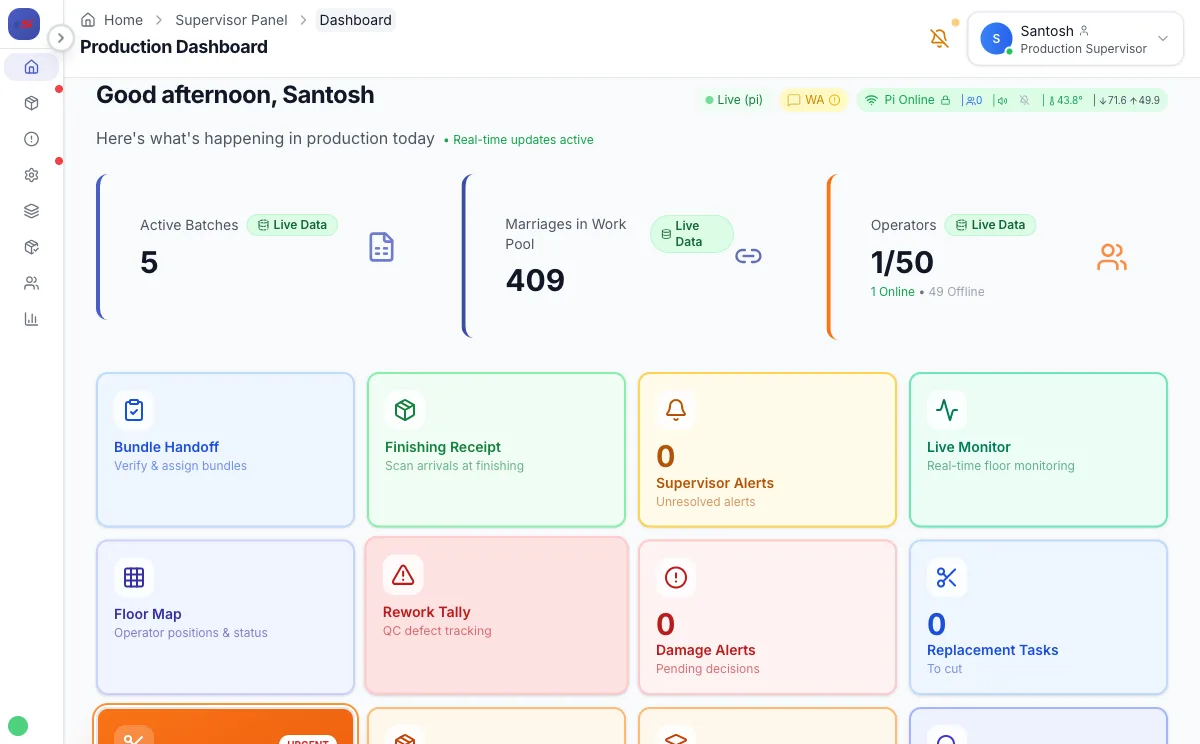
This is the category that handles actual floor operations: bundle tracking, operator scanning, WIP visibility, quality logging. STITCH MES, Scan ERP, and WFX Smart Factory fall here. These are the systems operators and supervisors interact with directly on the floor. This is the most critical category for CMT factories and the one most often missing from enterprise deployments.
4. India/South Asia Specific Garment ERP
A cluster of Indian vendors serve the mid-market: Rcomm Garment Software, LogicERP Garment, GarmentSoft, and others. These are GST-compliant, Tally-compatible, and support ZKTeco biometric integration. Pricing is typically ₹15,000–₹60,000/month for a full deployment. They serve the India, Bangladesh, and Nepal markets well but lack the global deployment support of enterprise vendors.
5. Generic Tools Adapted for Garments
Airtable, Zoho Operations, and Google Sheets with custom scripts. These work for very small operations (under 20 operators) but break down when you need real-time operator-level tracking and automated piece-rate calculation. They are a starting point, not a destination.
Vendor Comparison: What You Actually Get
| Software | Best For | QR Floor Tracking | Piece-Rate Payroll | Pricing Tier |
|---|---|---|---|---|
| Coats Digital FastReact | Production planning, large factories | No (planning only) | No | Enterprise |
| WFX Smart Factory | Mid-to-large export factories | Yes | Partial | Mid-to-Enterprise |
| Rcomm Garment | Indian factories, Tally integration | Yes | Yes | Mid-market |
| Scan ERP | Small-to-mid CMT factories (50–300 ops) | Yes | Yes (automatic) | SMB |
| SAP Business One | Large factories needing financial integration | With custom module | With custom module | Enterprise ($3,500+/user) |
The Four Questions That Separate Real Garment Software from Demos
Any vendor can produce a smooth demo. These four questions expose the gaps:
1. Show me a live floor scan — not a pre-recorded video
Ask the sales person to open a real demo environment and scan a bundle. Watch how fast the system responds. Watch what happens if the scan fails. A system that takes 3 seconds to respond per scan will create queues at every station on a floor with 50 operators.
2. What happens when the internet goes down?
Factory floors have dead zones. The software must queue scans locally and sync when connectivity returns. If the answer is "we recommend a strong WiFi network," that is not an answer.
3. How is piece-rate calculated — show me the formula
Ask for the exact calculation: which inputs, what multipliers, how skill levels affect the rate, how quality affects payout. If they cannot show you the formula, the calculation is happening in a black box — and your operators will not trust it.
4. What does implementation actually require?
Get a list: devices needed, WiFi requirements, training days, configuration time, data migration. "Implementation is straightforward" is not an answer. A system that needs 3 months of IT configuration will not survive in a factory that does not have an IT department.
What Garment Manufacturing Software Cannot Fix
Software does not fix poor supervision. It does not fix operators who find ways around scanning. It does not fix management that ignores the data the system produces.
The factories that see real ROI from garment manufacturing software share one characteristic: they changed their management practices at the same time as deploying the software. Supervisors review the hourly target vs actual in real time, not at end of shift. Piece-rate disputes are resolved by pulling scan logs, not by asking the supervisor to remember. QA issues are logged at the operation level and reviewed weekly.
The software enables these practices. It does not create them on its own.
For a deeper look at which features to prioritize and which to ignore, see the garment factory management software selection guide. For context on what the full ERP system should connect, see the garment factory ERP system complete guide.
What does Scan ERP cost?
Scan ERP costs $4 per machine per month, or $0.005 per finished piece tracked, whichever bills lower that month. A 50-machine CMT factory pays about $200 a month. There is no minimum, no per-user fee and no contract. Hardware is $1,500 to $3,000 one-time and bought separately.
See Scan ERP on Your Factory's Real Data
20-minute demo call. We use your actual lot numbers, machine count, and production flow — not a generic walkthrough.
Book a Free Demo →